When fire-rated doors are supplied to any project, the consultant's first question is: to which standard was the door tested? In most projects in the region the answer is one of two: British Standard (BS) or the American UL. Both systems aim for the same thing, a door that holds back fire and smoke for a defined time, but they differ in the test method, the rating periods and the construction of the door itself. That difference shows directly in the thickness, weight and price of the door.
In this article we explain the difference between the two systems in practical terms that help contractors and designers understand what the project requires.
What do BS and UL mean?
- BS: British Standards. Fire-rated doors are tested to BS 476 Part 22 or the European standard BS EN 1634-1, and the door is rated with the code FD followed by the number of minutes, such as FD30 and FD60.
- UL: the standards of Underwriters Laboratories in the United States. Doors are tested to UL 10C (positive pressure test) or UL 10B, and the door is rated in minutes or hours.
In both cases the door leaf is not tested alone. The whole assembly is tested: leaf, frame, hinges, lock, seals and glazing where fitted.
Quick comparison
| Criterion | BS | UL |
|---|---|---|
| Test standard | BS 476 Part 22 or BS EN 1634-1 | UL 10C or UL 10B |
| Common ratings | FD30, FD60, FD90, FD120 | 20, 45, 60 and 90 minutes for wooden doors (3 hours for steel doors only) |
| 120-minute rating | Available (FD120) | Not part of the rating scale |
| Hose stream test | Not required | Required after fire exposure |
| Leaf thickness | Increases with the rating | Usually standard door thickness |
| Common core | Dense timber cores or fire-resistant boards | Mineral core |
| Weight at 60 and 90 minutes | Heavier | Lighter |
1. Test method
In both systems the door is installed with its frame in a test wall in front of a furnace whose temperature rises along a standard curve, and the door is monitored for the full rating period.
The main difference comes after the fire exposure ends. In the UL test, a strong stream of water from a fire hose is directed at the hot face of the door, known as the hose stream test. Its purpose is to confirm that the door stays intact in its frame after thermal shock and the force of the water, conditions similar to what actually happens during firefighting. This test is not part of the British Standard, which is why the UL test is regarded as more severe in this respect.
The UL 10C test is also run under positive pressure, meaning hot gases press on the upper part of the door and try to pass through the gaps. For this reason UL doors rely on intumescent strips that seal these gaps.
2. Rating periods
- In BS: the common ratings are 30, 60, 90 and 120 minutes.
- In UL: 20, 45, 60 and 90 minutes for wooden doors, with 90 minutes as their upper limit. The 3-hour rating applies to steel doors only.
In practice: if the project specification calls for a 120-minute wooden door, the usual route is the British system, because a 120-minute rating is not part of the UL rating scale.
3. Thickness, weight and core
This is the difference the contractor notices on site.
In the British system, leaf thickness is linked to the rating. An FD30 door is usually 44 mm thick, FD60 about 54 mm and FD90 around 64 mm. As the rating increases, thickness and weight increase, and frame sizes and hinges change with them.
In the UL system a mineral core is typically used: a relatively light, heat-resistant inorganic board. With it the door achieves 60 and 90 minutes at a thickness close to that of a standard door, and at a lower weight than the British equivalent of the same rating.
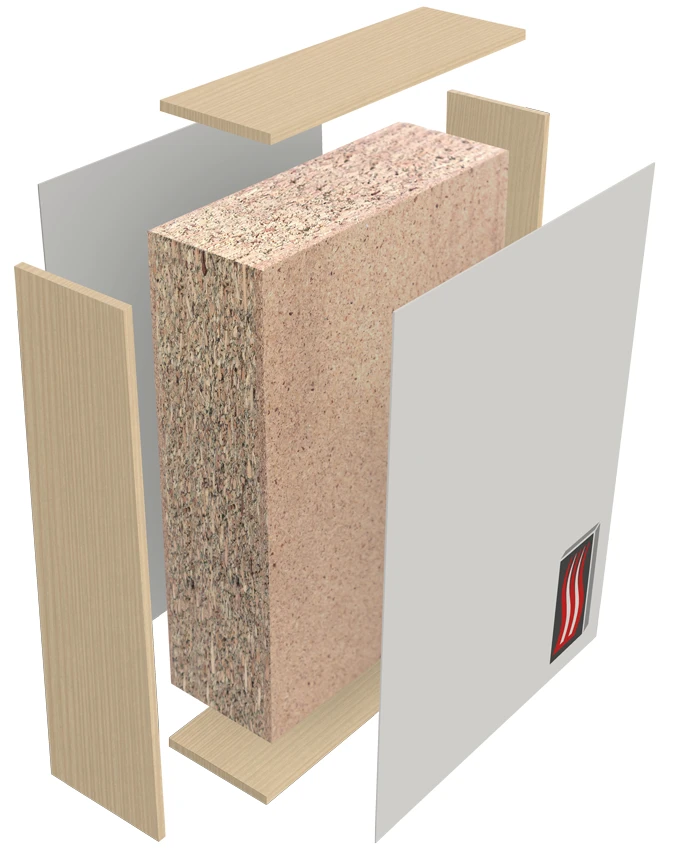
British system (BS): a dense timber core whose thickness increases with the rating
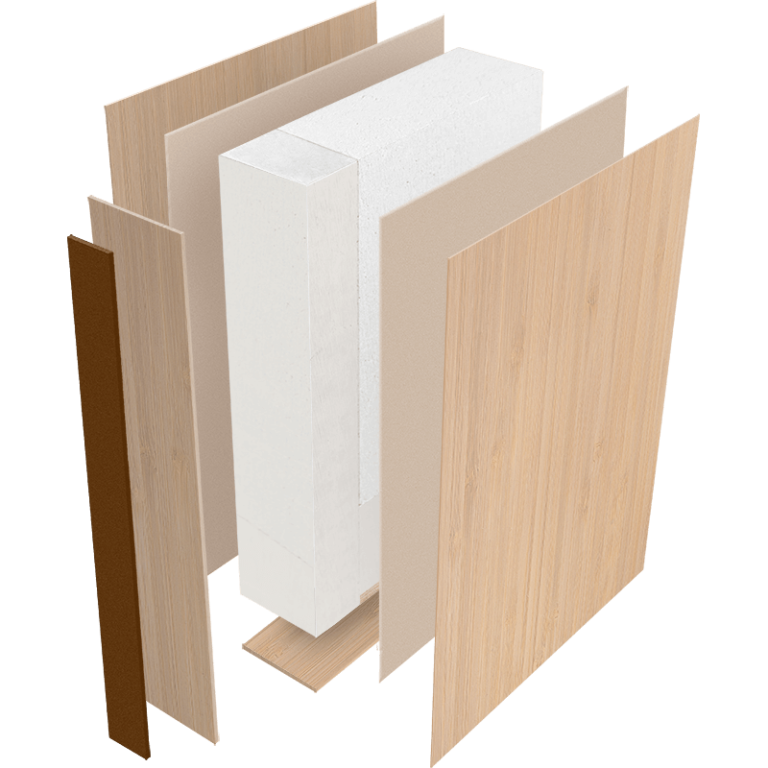
UL system: a mineral core at standard door thickness
Images courtesy of Halspan. Afkar Mumayaza factory (a branch of Mez United Industry Co.) is certified by IFC Certification to manufacture fire-rated doors using Halspan cores.
What does this mean for the project?
- One door thickness across the whole project, fire-rated or not, so frames and hardware look consistent.
- Less weight on hinges and closers, and easier daily use.
- The mineral core is an inorganic material, so it is less affected by moisture and mould than timber cores.
4. Smoke control
Fire is not the only danger: smoke is the leading cause of casualties in fires. In the British system the letter S is added to the rating (such as FD30S) for a door tested for smoke leakage. In the UL system smoke leakage is tested to a separate standard and indicated by the letter S on the door label.
5. Label and certification
A fire-rated door without a certification label is treated on site as an ordinary door, whatever its specification.
- UL doors carry a metal or adhesive label on the edge of the leaf and on the frame, showing the rating and the certification body.
- British doors carry a label or coloured plug under third-party certification schemes such as Certifire and Q-Mark.
The label must not be painted over or removed during installation.
Which one should you choose for your project?
The choice is not a matter of personal preference; the project documents decide it:
- The project specification and the requirements of the consultant and Civil Defense are the first reference.
- One system is not substituted for the other without the consultant's approval, even if the rating is the same, because the test method differs.
- If a 120-minute wooden door is required, the British system is the usual route.
- If 60 or 90 minutes is required with uniform door thickness and lower weight, the UL system offers a clear advantage.
- The assembly is approved as a whole: a certified door leaf with an uncertified frame or hardware is not enough.
Fire-rated doors from MEZ
At Mez United Industry Co. we produce fire-rated doors to the system set by the project specification, finished in HPL or natural veneer to match the other doors in the project, with the shop drawings and documents required for consultant approval.
Summary
BS and UL are two recognised routes to the same goal. The British system covers longer ratings, up to 120 minutes, and thickness increases with the rating. The UL system is more severe in its test because of the hose stream, and gives a lighter, slimmer door at 60 and 90 minutes thanks to the mineral core. The final decision always rests with the project specification and the consultant's approval.
Image credits: the images in this article belong to Halspan. Afkar Mumayaza factory, a branch of Mez United Industry Co., is certified by IFC Certification to manufacture fire-rated doors using Halspan cores (certificate IFCC1800 for BS and certificate IFCC 1998 for UL).
For details of the doors we manufacture and their certificates, visit our fire-rated doors page.
Read also: Fire ratings of 30, 60, 90 and 120 minutes: what they mean and how to choose
Send us your door schedule and the required fire standard, and we will prepare the technical and commercial offer.